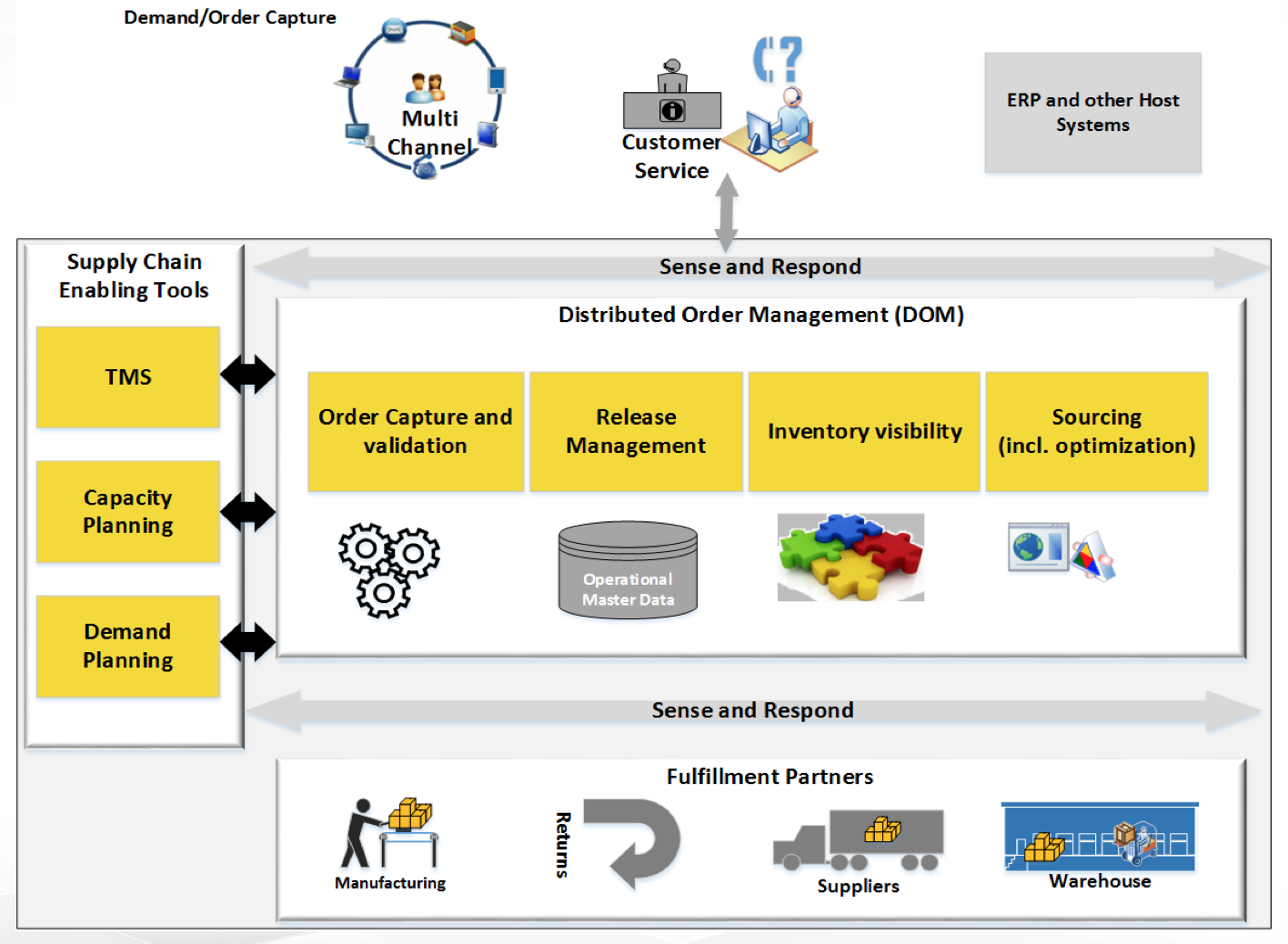
A distributed order management system brings orders, inventory, and fulfillment together across your entire network. It pulls in data from ecommerce, stores, marketplaces, warehouses, and suppliers, then decides the best way to fulfil each order in real time. If you are growing omnichannel operations, think of DOM as the control tower that keeps promises accurate, costs in check, and customers happy.
If you are asking what is distribution management system in the context of modern commerce, here is the short answer: it is the brain that coordinates where and how every order gets fulfilled, using live data from all nodes. In practice, that brain is a distributed order management platform—purpose-built software for orchestrating complex, multi-location fulfilment.
What is a distributed order management system (DOM)?
A distributed order management system is enterprise-grade software for order orchestration across dispersed inventory locations such as distribution centres, retail stores, micro-fulfilment sites, third-party logistics partners, and drop-ship vendors. The core job is simple to say, harder to do: route every order to the best node based on availability, delivery promise, cost-to-serve, and operational constraints.
DOM sits in the middle of your commerce and fulfilment stack. It connects to ecommerce and point of sale for order capture, synchronises with warehouse management, enterprise resource planning, and supplier systems for inventory and status, and integrates with carriers and returns tools for shipping and aftersales. With that connective role, a distributed order management platform becomes the decision engine that ensures what customers buy can be fulfilled efficiently and reliably.
How is it different from a traditional order management system software approach? Legacy models often assign orders to a single DC and rely on batch updates. That creates stockouts, higher shipping costs, and manual workarounds. DOM uses near real-time data, multi-node inventory awareness, and configurable rules to allocate, split, and re-route orders dynamically. It supports ship-from-store, buy online pick up in store (BOPIS), curbside pickup, same-day courier, and drop ship, while maintaining a single view of orders and inventory across all nodes.
If you are still wondering what is distribution management system at a practical level, it is a way to coordinate inventory and orders so you fulfil from the right place, at the right time, every time. That is the promise of modern distributed order management software.
How distributed order management works
DOM operates on three pillars: inventory visibility, order orchestration, and fulfilment decisioning. First, it consolidates inventory signals from warehouses, stores, 3PLs, suppliers, and even in-transit stock. Second, it manages the end-to-end order lifecycle—from capture and validation, through allocation and integration with pick/pack/ship, to delivery confirmation. Third, it applies decision logic to choose the best node and method to meet customer promises and business rules.
When an order comes in, the distributed order management platform evaluates a range of inputs, including:
- Inventory by location and status (on-hand, reserved, in-transit, holds)
- Pick/pack and carrier lead times, plus cut-off times
- Promised delivery dates and service levels
- Proximity to the customer and available shipping methods
- Carrier rates, surcharges, and performance metrics
- Node processing capacity and labor constraints
- Order value, margin, and handling needs (hazmat, temperature control, oversized)
- Store operating hours and shelf protection rules
- Sustainability policies like minimising splits or total miles
Modern distributed order management software is event-driven. New events—an order submission, stock receipt, return initiation, or carrier delay—trigger rules that allocate, re-allocate, or split orders as conditions change. Integrations typically use REST APIs, message queues, webhooks, and prebuilt connectors to ecommerce, ERP, WMS, TMS, POS, carrier networks, and returns tools. With continuous event exchange, the system keeps delivery promises accurate and adjusts fulfilment in flight when reality shifts.
Business benefits you can expect
Deploying a distributed order management system delivers measurable gains across cost, speed, and accuracy. With location-aware routing and live stock visibility, organisations ship from the closest viable node, reduce splits, and lower parcel spend. Intelligent allocation improves pick efficiency and cuts cancellations caused by overselling. The net effect: faster cycle times and lower fulfilment cost per order.
Customer experience benefits too. DOM enables flexible options like ship-from-store to leverage local inventory, BOPIS or click-and-collect for convenience, and same-day courier in select regions. It supports order splitting when needed to meet promised dates, coordinating partial shipments and notifications so customers stay informed from purchase to delivery.
For enterprises spanning multiple regions or facing seasonal surges, DOM adds resilience. Capacity-aware routing balances workloads across nodes, while automated exceptions and reallocation help you handle carrier delays and sudden stockouts. Because a distributed order management platform is channel-agnostic, it makes it easier to expand into marketplaces and new geographies without losing control of service levels or margins.
| Benefit Area | Outcome | Typical Impact |
| Shipping and logistics cost | Closest-node selection, fewer splits | Reduced parcel spend and surcharges |
| Oder cycle time | Faster allocation and execution | Shorter time from capture to ship |
| Inventory accuracy | Real-time, multi-node visibility | Fewer stockouts and cancellations |
| Labor efficiency | Smarter allocation and batching | Higher pick rates and throughput |
| Customer expereince | Reliable promises and flexible options | Higher conversion and repeat purchase |
| Scalability | Capacity-aware routing and automation | Stable performance during peaks |
Key features to look for
Inventory- and location-aware routing. Your distributed order management software should maintain a single, near real-time view of inventory across all nodes and support rules that prioritize closest ship-from, lowest cost, capacity, or margin. Look for safety stock controls, backorder logic, preorders, and robust ATP and CTP capabilities.
Rules-based fulfilment and exception management. A configurable rules engine lets you define service tiers, carrier selections, split-ship logic, and cut-off times. Exception workflows should flag and resolve issues like stock shortages, address validation failures, and carrier exceptions, with alerts and automatic reallocation to keep orders moving.
Integration and analytics. Enterprise-grade APIs, connectors, and event streaming are essential for synchronising with ecommerce, ERP, WMS, TMS, POS, carrier networks, and returns platforms. Real-time dashboards should cover order status, aging, capacity, fill rates, on-time performance, and cost-to-serve, with drill-down and alerting to drive continuous improvement.
Support for complex orders and returns. The distributed order management platform should handle kits and bundles, scheduled delivery, curbside pickup, partial shipments, drop ship, and marketplace orders. Returns features such as RMA creation, disposition rules, and restock updates help maintain inventory accuracy. Orchestration across pick/pack/ship and label generation integrations ensure end-to-end control.
If you are comparing software for order management system options, put adaptability high on your list. Business rules change. Your order management system software should keep up without custom code every time you adjust a promise or launch a new channel.
Implementation considerations and best practices
Start with data. Strong master data is non-negotiable. Establish a single source of truth for product, location, and customer data. Align item identifiers, units of measure, and pack hierarchies across systems. Implement disciplined inventory reconciliation—cycle counts, store audits, and automated variance detection. Standardise definitions for on-hand, hold, reserve, and in-transit so DOM’s ATP view is trustworthy.
Take a phased approach. Begin with a subset of SKUs, locations, and channels to validate routing rules, service levels, and integrations. Test thoroughly across functional, performance, and failover scenarios. Include stakeholders from merchandising, logistics, store operations, finance, and IT to align rules with customer promises and margin targets.
Design for scale and security from day one. Your distributed order management system should support elastic scaling during peak seasons and multi-region deployments with low latency. Plan for high availability, disaster recovery, and strong observability with metrics and distributed tracing. Apply role-based access controls, encrypt data in transit and at rest, and use secure integration patterns. If migrating from a legacy OMS, run systems in parallel during cutover and map equivalencies for order states, inventory buckets, and service levels to preserve reporting continuity.
- Set clear service-level objectives by channel and region to guide routing rules.
- Define capacity models for each node to avoid overloading stores or DCs.
- Use A/B tests on routing strategies to balance cost-to-serve and promise accuracy.
- Create playbooks for exceptions, including carrier delays and inventory variances.
- Train store and warehouse teams on prioritisation logic and exception handling.
Common use cases, metrics and scenarios
Omnichannel retail. Enable ship-from-store to reduce delivery distance, support BOPIS and curbside pickup, and implement dynamic safety stock to protect shelves. The DOM determines in real time whether to ship from a store, a regional DC, or a 3PL based on proximity, capacity, and the promised date.
Marketplace and drop-ship sellers. Consolidate orders from marketplaces, route to vendors or internal nodes, and enforce vendor SLAs and label standards. The distributed order management platform centralises tracking and ensures consistent customer communications even when third parties fulfil.
Distributed warehousing and micro-fulfilment. Orchestrate inventory across regional DCs and micro-fulfilment centres to meet same-day or next-day promises. DOM balances loads and prevents bottlenecks during promotions and seasonal peaks.
Returns and reverse logistics. Generate RMAs, present smart return options based on customer location and item type, and trigger restock or refurbishment workflows. The distributed order management system updates availability promptly to reduce out-of-stocks and improve recovery rates.
Key performance indicators to track include:
- Order cycle time from capture to ship
- Fill rate, perfect order rate, and on-time in-full (OTIF)
- Fulfilment cost per order and cost-to-serve by node
- Split-ship percentage and distance per package
- Cancellation rate and backorder duration
- Return-to-stock time and inventory accuracy variance
Link promise accuracy to conversion and customer satisfaction. Correlate carrier performance with cost and service tiers, and refine routing rules. This is where software for order management system choices can make a difference—the better the analytics and alerting, the faster you improve outcomes.
Migration from legacy from OMS: a practical path
Moving from a legacy OMS to a modern distributed order management software approach is a step-by-step process. Start with discovery and data cleansing. Document current order states, allocation logic, and exception handling. Design future-state rules that reflect service commitments, cost objectives, and capacity plans. Stand up integrations in a test environment and run shadow operations in parallel to compare outcomes. Shift traffic in phases by channel, region, or SKU class. Establish rollback plans and communication playbooks for stores, contact centres, and warehouses to maintain continuity and confidence during cutover.
At minimum, integrate these systems:
- Order capture: ecommerce platform and POS
- Enterprise backbone: ERP for financials, tax, and item master
- Execution: WMS and 3PL systems for inventory and fulfilment
- Transportation: TMS, carrier networks, and label generation
- Customer engagement: notification and returns management tools
Use APIs and webhooks for low-latency updates, and event streaming for high-volume flows or when you need to fan out events to multiple consumers. The goal is a DOM that is well-connected, responsive, and resilient.
Peak readiness and multi-region operations
Peaks happen—promotions, holidays, flash sales. Prepare by stress testing routing and capacity thresholds. Pre-position inventory using demand forecasts and consider region-aware rules that contain shipments within borders when possible. For global coverage, deploy active-active across regions to keep latency low and uptime high. Monitor node performance in real time and apply throttles or temporary rule changes to protect critical SLAs during peak windows.
Making the right choice
Choosing software for order management system needs is about fit. Make sure the distributed order management software you select can support your channels, your network, and your service promises without forcing you into rigid processes. Confirm that the order management system software is built for change—new carriers, new nodes, new business rules—and that the analytics make it easy to learn and improve. If it helps you keep promises at lower cost, you are on the right track.
In short, distributed order management gives you the visibility and control to scale omnichannel profitably. A well-implemented distributed order management system brings order to complexity. And a flexible distributed order management platform lets you adapt as your business grows, without starting over every time market conditions shift.
FAQ
Traditional OMS models assign orders to a central DC and update inventory in batches. A DOM synchronises inventory across all nodes and uses real-time decisioning to allocate, split, or re-route. The results are shorter delivery distances, lower shipping costs, fewer stockouts, and support for omnichannel options like ship-from-store and BOPIS.
Most organisations see quick gains in accurate availability, fewer split shipments, and lower parcel spend. DOM also reduces cancellations caused by stock inaccuracies and improves throughput by sending the right work to the right node at the right time.
Yes. A distributed order management platform is designed to integrate via APIs, message queues, and connectors. It makes allocation decisions while WMS and ERP handle execution and finance. Clean master data and consistent inventory status definitions are essential.
It depends on scope and integration complexity. A phased rollout targeting a subset of SKUs and locations can deliver value in months, while full-scale programmes may take several quarters. Many businesses see ROI within 6 to 18 months.
Key inputs include location-level inventory (on-hand, reserved, in-transit), pick/pack and carrier lead times, carrier rates and services, node capacity and operating hours, and routing rules tied to service levels and margins. Sustainability preferences, hazardous handling, or shelf protection can further refine decisions.
The system evaluates whether splitting is needed to meet promised dates or reduce costs. If a split is optimal, it coordinates partial shipments, labels, and customer notifications, tracking each leg through delivery while maintaining a single view of the order.
Track order cycle time, fill rate, perfect order rate, OTIF, fulfilment cost per order, split-ship percentage, distance per package, cancellation rate, backorder duration, and return-to-stock time. Monitor promise accuracy and link it to conversion and customer satisfaction.
Yes. Capacity-aware routing, dynamic throttling, and event-driven reallocation help maintain service levels during promotions and surges by balancing workloads and resolving exceptions in real time.
Routing rules can prioritise shorter delivery distances, consolidate shipments to reduce packaging, and choose carriers with favourable emissions profiles. DOM can limit splits and favour inventory nodes that reduce total miles travelled.
Look for role-based access controls, encryption in transit and at rest, audit logging, and secure integration patterns. For regulated items, include controls for age verification, hazardous materials, or temperature sensitivity within routing and exception rules.
Yes. Integrating POS and store inventory enables dynamic shelf protection, limits store workload during peak foot traffic, and selects stores for fulfilment based on capacity and the impact on in-store service.