
Why the next generation of warehouse AI must optimize its assigned task and the entire operation.
For years, warehouse technology has been designed around individual functions. One system manages labor. Another releases waves. Another monitors automation. Each performs an important job, often exceptionally well.
But a warehouse does not operate as a collection of independent functions.
Every decision affects something else. Releasing a wave changes labor requirements. Replenishing a pick face can create aisle congestion. Redirecting associates may solve one bottleneck while creating another. Increasing the speed of automation means little if downstream capacity cannot absorb the additional volume.
This interconnectedness creates a challenge for the next generation of warehouse AI.
An AI worker cannot simply be evaluated by how well it completes its assigned task. It must also understand how its decisions affect the broader operation.
At IFS Softeon, we believe every warehouse AI worker should have two jobs:
- Do its own job exceptionally well.
- Make the entire warehouse perform better.
That is the dual mandate of warehouse AI.
Mandate One: Do the Job Exceptionally Well
The first mandate is the most familiar. An AI worker must be deeply capable within its assigned area.
A wave management AI worker should understand order priorities, carrier cutoffs, picking strategies and wave configurations. A labor AI worker should understand employee skills, staffing requirements, break schedules and productivity patterns. An automation AI worker should understand equipment status, capacity, throughput and potential constraints.
But genuine expertise requires more than following predefined rules.
The AI worker should understand how the warehouse has been configured, how the operation typically behaves and how experienced managers respond when conditions change. It should be able to evaluate information, recommend or take appropriate action, explain its reasoning and learn from the outcome.
In other words, it should not simply automate a transaction. It should bring an informed point of view to the task.
Consider wave management.
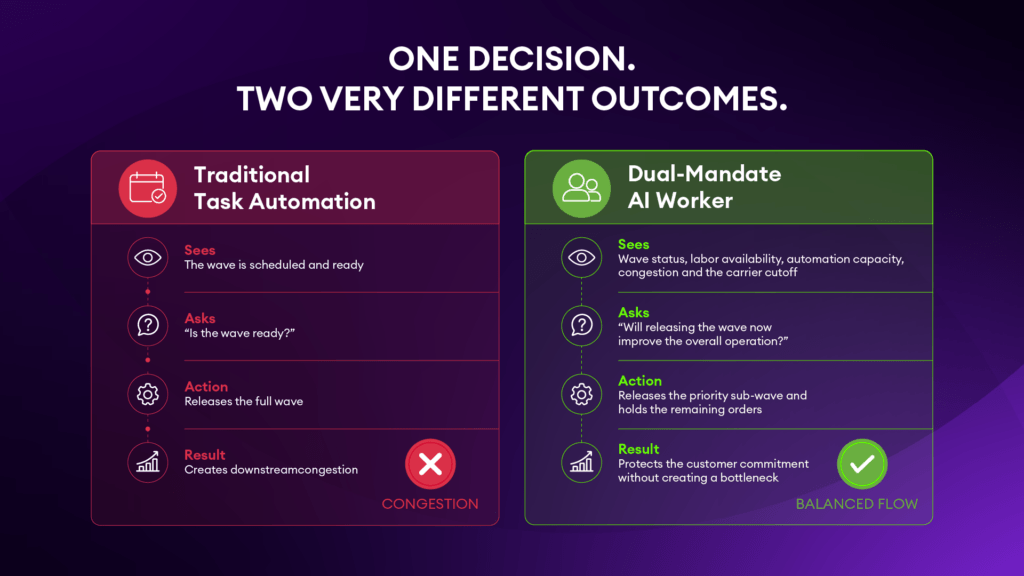
A traditional rule might say that when a wave reaches its scheduled release time, the system should release it. A more capable AI worker would evaluate whether releasing the wave is still the right decision based on the orders, priorities and deadlines involved.
That represents meaningful progress, but it is only the first mandate.
Mandate Two: Make the Entire Operation Better
The second mandate is what can turn specialized AI into true warehouse intelligence.
Before taking an action, the AI worker should consider the current state of the entire operation. It should understand the warehouse’s goals, available labor, automation capacity, physical layout and the relationships between different operational areas.
Instead of simply asking:
Is the wave ready to be released?
It should ask:
Should I release the wave now, or wait three minutes because labor is short and automation is congested?
This is a fundamentally different way of thinking about warehouse AI.
The first question focuses on completing a task. The second considers whether completing that task at that moment will improve the operation, or unintentionally make it worse.
An AI worker operating under a dual mandate may decide to proceed, delay, modify or escalate an action based on the broader context. Success is not defined solely by whether the individual task was completed. It is defined by whether the decision helped the warehouse achieve its overall objectives.
From Local Optimization to Warehouse-Wide Performance
Warehouses have long struggled with the difference between local optimization and operational improvement.
A replenishment process can hit its productivity target while creating congestion in an active picking aisle. Automation can run at maximum speed while overwhelming a downstream buffer. Labor can be reassigned to address an immediate issue while leaving a priority order without the resources needed to meet its carrier cutoff.
Each function may appear to be performing well according to its own metrics. The warehouse as a whole may still fall behind.
The dual mandate provides a different model.
An AI worker responsible for replenishment would still protect pick-face availability. But it would also understand when active picking makes a particular aisle too congested for replenishment. It might delay the task briefly, select a different route or prioritize another location until congestion clears.
An AI worker responsible for labor would still match available associates with operational demand. But it would also recognize an upcoming wave, a developing automation constraint or a critical outbound deadline. It could reposition labor before a bottleneck develops rather than reacting after throughput begins to decline.
An automation AI worker would still monitor equipment health and utilization. But instead of maximizing the speed of every machine, it could adjust the flow of work based on what the rest of the operation can handle.
In each example, the AI worker remains accountable for its own job. It simply performs that job with an understanding of the larger environment.
What the Dual Mandate Looks Like in Practice
Imagine that it is 1:45 p.m. A wave is queued for release, and the carrier cutoff is at 3:30 p.m.
Under normal conditions, releasing the wave would be the obvious decision. But the current warehouse conditions tell a more complicated story:
- A goods-to-person cell supporting one of the primary picking zones is operating below normal capacity.
- The affected zone has two fewer associates than planned.
- Releasing the full wave could overwhelm the buffer and create additional queuing.
- A priority order for a major customer is included in the wave and must meet the carrier cutoff.
An AI worker focused only on wave management might release the entire wave because it is scheduled and ready.
An AI worker operating under a dual mandate would evaluate the wider operational context. It might release a smaller sub-wave containing the priority order, coordinate additional labor for the affected zone, hold the remaining orders until automation capacity recovers and then reassess conditions.
The wave still progresses. The customer commitment is protected. But the warehouse avoids creating a larger downstream bottleneck.
That is the difference between completing a transaction and improving the operation.
AI Workers Need a Shared Operational Picture
For the dual mandate to work, AI workers need more than access to isolated streams of data. They need a shared understanding of the warehouse.
That operational picture should include:
- The facility’s layout, configurations and established processes
- Current activity and developing conditions across the warehouse
- The operational relationships between zones, aisles, docks and systems
- Daily goals, service-level commitments and carrier cutoffs
- Available labor, employee skills and staffing constraints
- The health, capacity and utilization of automation
These factors mirror the information experienced warehouse managers carry in their heads throughout a shift.
They know that one zone feeds another. They understand that releasing additional work can overwhelm a downstream process. They know which customer commitment cannot be missed, which associate has the right skills, and which piece of automation is beginning to slow.
The next generation of warehouse AI should be able to reason with that same type of context.
Just as importantly, AI workers should contribute what they observe back into a shared intelligence layer. When an automation AI worker identifies a degraded cell, the wave management AI worker should be able to incorporate that information before releasing more work. When the labor AI worker detects a staffing shortage, other AI workers should adjust their decisions accordingly.
The result is not a collection of isolated bots. It is a coordinated digital workforce operating from a common understanding of the warehouse.
A Better Standard for Warehouse AI
The warehouse industry should expect more from AI than faster task execution.
Speed matters. Productivity matters. Automation matters. But optimizing individual activities without understanding their operational impact can simply create problems faster.
The more meaningful opportunity is to develop AI workers that combine specialized expertise with warehouse-wide awareness.
Every AI worker should be able to answer two questions:
Am I doing my job well?
Is what I am doing helping the entire operation perform better?
When both answers are yes, AI becomes more than another layer of automation. It becomes a source of coordinated, operational intelligence, helping warehouses anticipate constraints, balance competing priorities and make better decisions across the flow of work.
That is the dual mandate. And it should become the standard for the next generation of warehouse AI.
To learn how IFS Softeon is helping organizations build more connected, adaptable and intelligent warehouse operations, contact our team.