


A recent Gartner report, Artificial Intelligence Use-Case Comparison for Logistics, outlines 20 AI-enabled use cases across warehousing, transportation, and fulfillment, each scored on feasibility and business value.
For logistics leaders, this framework serves as a roadmap to identify quick wins, calculated bets, and emerging opportunities for transformation.
The Gartner Framework: Value vs. Feasibility
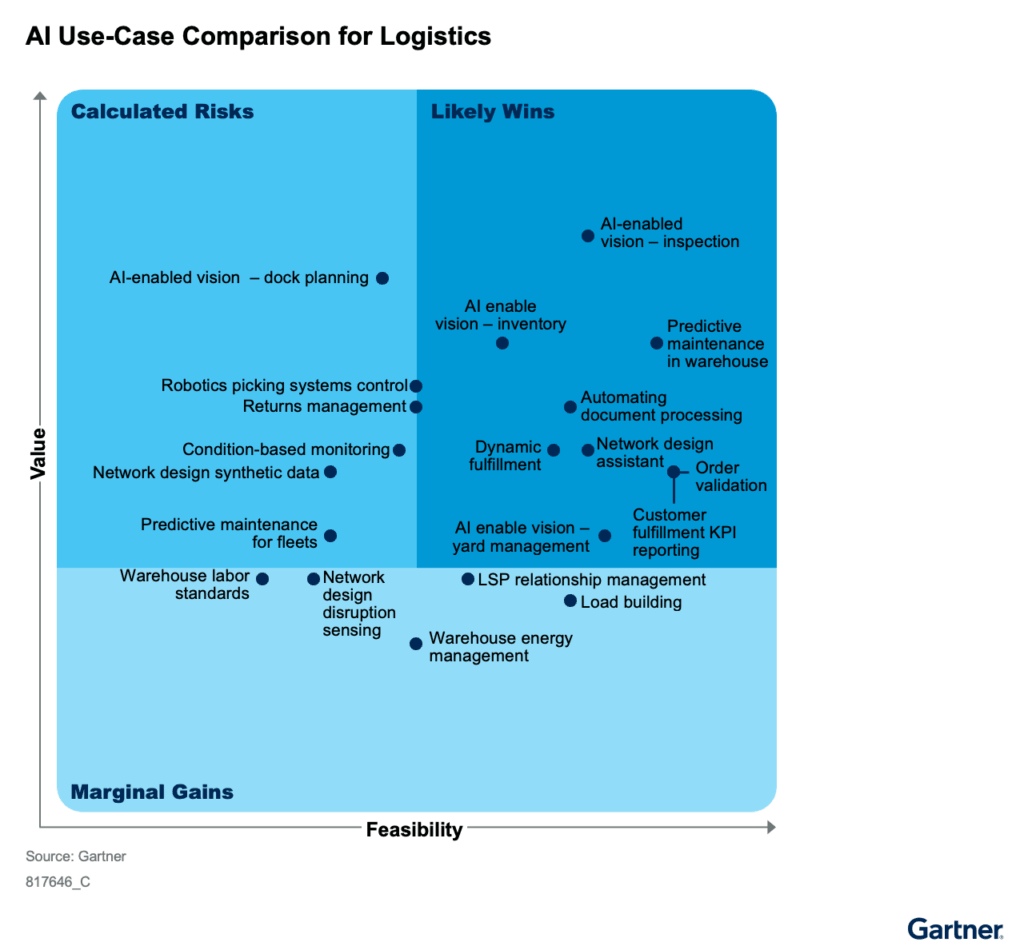
Gartner groups AI opportunities into three categories:
1. Likely Wins (High Feasibility and High Value)
These are the AI use cases logistics leaders can prioritize with confidence:
- Vision-enabled inspection: Using computer vision to detect damages on inbound and outbound shipments, improving safety and eliminating manual inspection.
- Predictive maintenance in warehouses: Leveraging IoT and AI to anticipate equipment failures before they occur, reducing downtime.
- Automating document processing: Extracting data from invoices and bills of lading, reducing manual entry errors while speeding verification.
- Dynamic fulfillment: Late-stage allocation of inventory based on real-time POS and stock data, ensuring higher on-shelf availability and reduced delivery times.
- Returns management: Automating inspection of returns with vision tech to determine if items can be restocked, refurbished, or recycled.
- AI-powered KPI reporting: Providing real-time dashboards of fulfillment and customer metrics, allowing faster course corrections.
- AI-enabled vision in yard and inventory management: Drones, mobile robots, and sensors providing accurate inventory counts and real-time yard visibility.
Gartner’s framework is visualized below in a 2×2 matrix plotting Feasibility vs. Business Value. Likely Wins sit in the high-value, high-feasibility quadrant, while Calculated Risks and Marginal Gains occupy other areas of the chart.
2. Calculated Risks (High Value and Lower Feasibility)
These hold promise but require more organizational readiness and technical maturity:
- Warehouse energy management: AI-driven models to predict and optimize energy use, lowering costs and environmental impact.
- Load building optimization: Machine learning-powered recommendations for optimal loading patterns to maximize space and minimize errors.
- Warehouse labor standards via Machine learning: Replacing time-consuming industrial engineering studies with AI-driven benchmarks.
- Network design disruption sensing: AI-generated network scenarios that anticipate disruptions in transportation lanes, modes, or facilities.
To see where these AI capabilities impact operations, consider a pipeline view across logistics functions. Each phrase from Network Design to Customer Fulfillment can benefit from AI, highlighting practical applications of the Gartner use cases.
3. Marginal Gains (Lower Value or Niche Feasibility)
While these may add incremental improvements, they’re less likely to be enterprise priorities:
- Condition-based monitoring during transit: Using IoT and AI to monitor refrigerated shipments and prevent spoilage.
- Synthetic data for network design: Creating “what if” scenarios without relying solely on historical data.
- AI-enabled dock planning: Predicting bottlenecks and optimizing scheduling at dock doors.
- Fleet predictive maintenance: Using AI to forecast vehicle maintenance needs, improving uptime.
Why This Matters
The Gartner analysis makes it clear that AI is not a one-size-fits-all play. Some solutions, like automated document processing, are feasible for most organizations today, while others, like disruption sensing or synthetic data modeling, require stronger data pipelines and cultural readiness.
AI adoption in logistics must be staged, starting with feasible, high-value use cases and scaling into more advanced capabilities as organizations mature.
Softeon’s AI Advantage
At Softeon, we’ve built our Softeon AI Layer (SAIL) with this staged approach in mind by helping customers quickly capitalize on today’s “Likely Wins” while preparing for the more advanced capabilities Gartner identifies as “Calculated Risks.”
With SAIL, customers gain:
- Dynamic Fulfillment & Order Validation: Real-time allocation and automated order verification to increase accuracy and service levels.
- Intelligent Labor Planning: AI-driven labor standards that evolve with your operation.
- Automated Document Processing: Direct integration into WMS workflows for faster throughput.
- Predictive Analytics & Reporting: Real-time KPI dashboards and anomaly detection for proactive decision-making.
Gartner subscribers can read the full report to learn more.
If you’d like to learn more about Softeon’s AI capabilities or dive into the Gartner research together, contact us today.